
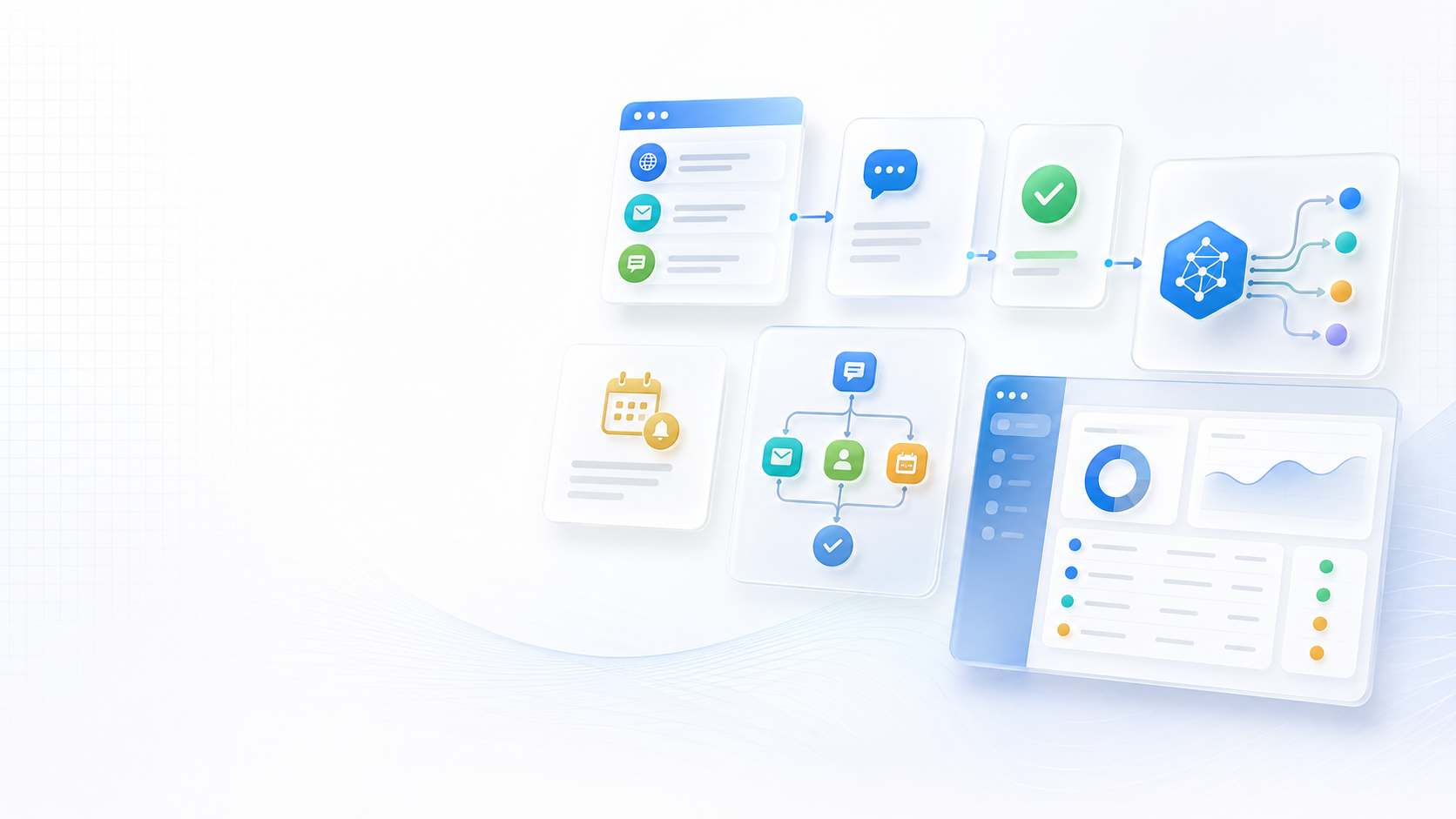
Quick check
Are your website enquiries reaching the right place?
If your website looks fine but leads are quiet, the issue may be hidden in your forms, email delivery, contact flow, messaging, or visibility.
How AI Automation Can Help Small Businesses Respond Faster to Enquiries
When someone sends an enquiry, they are usually interested now.
They may be comparing providers. They may need a quote. They may want to book a service. They may have a question before making a decision. They may be ready to take the next step, but only if the business responds clearly and quickly.
This is where many small businesses lose opportunities.
Not because the service is poor.
Not because the website is useless.
Not because the customer had no interest.
But because the response process is too slow, too manual, or too easy to forget when the business gets busy.
A website enquiry may arrive during a job, meeting, school run, appointment, delivery, or busy working day. A message may land in the inbox, but nobody sees it quickly. A contact form may need reviewing manually. A quote request may need copying into a spreadsheet. A booking enquiry may need checking against availability. A follow-up may depend on someone remembering later.
These delays feel normal inside a busy business.
But to the customer, delay can create doubt.
They may wonder whether the business is active. They may contact a competitor. They may lose interest. They may forget why they enquired in the first place.
For many UK SMEs, faster enquiry handling is one of the most practical areas where AI automation can help.
Not by replacing people, but by supporting the routine steps that happen around customer communication.
If you want help improving enquiry handling, customer response workflows, or internal automation, explore our AI Integration service, Website Audit service, or book a consultation.
Speed matters because customer attention is short
When a potential customer contacts a business, they are often in decision mode.
That moment has value.
They have already taken action. They have visited the website, read something, clicked a button, filled in a form, sent an email, or asked a question.
If the business responds quickly, it keeps the momentum alive.
If the response is delayed, that momentum can fade.
This is especially true online. Customers are used to fast communication. They may not expect an instant human reply every time, but they do expect some reassurance that their enquiry has been received and that the business is organised.
A slow response can make the business feel less professional, even when the team is genuinely working hard.
That is why response speed is not only an admin issue.
It is part of trust.
A faster, clearer enquiry process helps customers feel that the business is active, reliable, and ready to help.
AI automation can support this by making sure the first steps happen without delay. The customer can receive acknowledgement. The business can receive structured details. The enquiry can be routed or prioritised. Follow-up reminders can be created automatically.
That gives the team a better chance of responding properly, without relying entirely on memory or manual checking.
The first reply does not always need to be complicated
Many businesses delay responding because they feel they need to give a complete answer straight away.
But the first response does not always need to solve everything.
Sometimes it simply needs to reassure the customer.
A good first response can confirm that the enquiry has been received, explain what happens next, set expectations, and provide helpful information while the business prepares a proper reply.
For example, if someone requests a quote, the first response can confirm the request and explain the next step. If someone books a consultation, the response can confirm the details. If someone asks a common question, the response can point them toward useful information.
This does not remove the need for human follow-up.
It creates a better starting point.
AI automation can help generate or trigger these first responses more reliably. The goal is not to send cold, robotic messages. The goal is to make sure the customer is not left wondering whether anyone received their enquiry.
That small improvement can make the business feel more professional.
It can also reduce repeated chasing from customers, because they know the message has been received.
AI automation can help organise enquiry details
A common problem with manual enquiry handling is that information arrives in different formats.
One customer sends a short message.
Another fills in a long form.
Another emails directly.
Another contacts the business through social media.
Another asks several questions at once.
Someone on the team then has to read everything, understand what is needed, and decide what should happen next.
This takes time.
It can also create mistakes.
Important details may be missed. The enquiry may not be categorised properly. A high-value lead may sit in the same inbox as a general question. A booking request may not be separated from a support issue.
AI automation can help by organising information more clearly.
For example, an enquiry can be classified by service type, urgency, location, budget range, customer intent, or next action. The system can extract key details and present them in a cleaner format for the team.
This makes the enquiry easier to handle.
The human still makes the decision, but they start with better information.
For busy small businesses, this can reduce the time spent reading, sorting, copying, and interpreting messages.
Automated acknowledgements reduce uncertainty
One of the simplest forms of automation is an acknowledgement email.
When a customer submits a form, they receive a message confirming that their enquiry has been received.
This sounds basic, but many websites still do not handle it well.
Some forms show only a small success message on the page. Some do not send customer confirmations. Some send poorly written emails. Some send from strange addresses that look unprofessional. Some do not explain when the customer can expect a reply.
A better acknowledgement can improve trust immediately.
It can say thank you. It can confirm the enquiry. It can explain the expected response time. It can include the business contact details. It can suggest the next step. It can link to useful pages.
This helps the customer feel safer.
It also makes the business feel more organised.
AI automation can make acknowledgements more useful by adapting them to the type of enquiry. A quote request, booking request, support question, and consultation enquiry may each need a slightly different response.
This kind of automation does not need to be complex.
It simply makes the customer journey cleaner.
AI can help answer common questions
Many businesses receive the same questions repeatedly.
How much does it cost?
How long does it take?
Do you cover my area?
What is included?
How do I book?
What information do you need from me?
Can you help with this specific problem?
These questions matter, but answering them manually every time can take attention away from other work.
AI-powered assistants and automated response flows can help by answering common questions in a controlled and useful way.
This can happen through a website chatbot, enquiry assistant, internal support tool, or guided form flow.
The important part is accuracy.
An AI assistant should be based on the business’s real services, policies, pricing structure, process, and contact routes. It should not invent answers or pretend to know things it does not know.
Used properly, AI can help customers get useful information faster while still allowing the business to step in when human judgement is needed.
For small businesses, this can improve both customer experience and operational efficiency.
Customers get answers sooner.
The team spends less time repeating the same basic information.
AI should support human service, not replace it
One concern many business owners have is that AI will make the customer experience feel cold or impersonal.
That can happen if automation is used badly.
But good automation should do the opposite.
It should remove repetitive friction so that the human side of the business becomes stronger.
For example, AI can help organise enquiries, prepare summaries, draft responses, trigger reminders, and answer basic questions. The team can then spend more time on the parts that need judgement, empathy, advice, pricing, decision-making, and relationship-building.
This is especially important for service businesses.
Customers still want to feel understood. They still want to speak to a real person when needed. They still want confidence that the business cares about their enquiry.
AI automation should not pretend to be a replacement for genuine customer service.
It should support better customer service by making the routine parts more reliable.
The best use of AI is often behind the scenes.
It helps the business respond faster, stay organised, and avoid missed steps.
Lead routing can prevent enquiries from sitting in the wrong place
In many small businesses, enquiries arrive in one shared inbox or contact form.
That can work at the beginning, but it becomes harder as the business grows.
Different enquiries may need different people.
A sales enquiry may need one response path. A support request may need another. A booking request may need availability checking. A finance question may need accounts. A technical issue may need a specialist.
If all messages land in the same place, important enquiries can be delayed.
AI automation can help route enquiries more intelligently.
Based on form answers, keywords, service selection, urgency, or customer type, the system can send the enquiry to the right person or department. It can apply labels. It can create tasks. It can notify the correct team member. It can store the enquiry in the right place.
This reduces confusion.
It also helps the business respond faster because the enquiry does not need to be manually passed around before anyone acts.
For small teams, even simple routing can make a noticeable difference.
The goal is not to create a complicated system.
The goal is to make sure enquiries reach the right person sooner.
Follow-up reminders help stop leads being forgotten
Many leads are not lost at the first response.
They are lost during follow-up.
A customer asks for information. The business replies. The customer goes quiet. Someone means to follow up later, but the day gets busy. A few days pass. The lead becomes cold. The opportunity disappears.
This is very common.
Most small businesses do not lose follow-ups because they do not care. They lose them because there is no reliable system.
AI automation can help by creating reminders and follow-up tasks.
For example, if a quote is sent and no response arrives after a set period, the system can remind the team. If a consultation request is received, the system can trigger a next-step checklist. If a lead is marked as high priority, the business can receive an alert.
This helps prevent opportunities from depending entirely on memory.
It also creates a more consistent customer journey.
Follow-up should not feel aggressive or pushy. It should feel helpful and professional.
A simple reminder can be enough to keep the conversation moving.
AI automation can connect website forms with business systems
A website form is often the beginning of a business process.
But in many businesses, the form is disconnected from everything else.
Someone receives an email. Then they manually copy details into a spreadsheet, calendar, CRM, project board, invoice system, or task list.
This creates repeated admin.
It also creates risk.
Details can be copied incorrectly. Messages can be forgotten. Tasks can be missed. Customer information can be spread across too many places.
AI automation and workflow tools can help connect these steps.
A form submission can create a lead record. It can send a notification. It can trigger a customer confirmation email. It can create a task. It can add a calendar reminder. It can update a spreadsheet or CRM. It can notify the right person.
This turns the website into part of the business system, not just a standalone page.
For growing SMEs, this is valuable because the website becomes more useful after the enquiry is submitted.
It supports the work that happens next.
Better enquiry handling improves conversion
Many businesses think website conversion only happens before the form is submitted.
That is not quite true.
Conversion continues after the enquiry.
A customer may submit a form but still choose another business if the response is slow, unclear, or disorganised.
The post-enquiry experience matters.
How quickly does the business respond?
Does the customer receive confirmation?
Is the next step clear?
Does the business ask for the right information?
Is the follow-up professional?
Does the customer feel confident?
AI automation can improve this stage by making the process more consistent.
It helps reduce delay, confusion, and missed steps.
This means AI automation is not only an operational tool. It can also support sales performance.
A business that responds clearly and quickly often has a better chance of converting interested visitors into real customers.
That is why enquiry automation should be considered part of the wider website and growth strategy.
A strong website brings the lead in.
A strong workflow helps turn that lead into a conversation.
AI can help create better internal summaries
Long enquiries can take time to understand.
A customer may explain their situation in detail. They may include several questions. They may attach information. They may describe a problem in an unstructured way.
Before responding, someone on the team has to read everything carefully.
AI can help by creating internal summaries.
It can highlight the customer’s main need, service interest, urgency, missing information, and suggested next steps.
This can be useful for busy teams because it reduces the time needed to understand the enquiry.
The human still reviews and decides.
But the starting point is clearer.
For example, an internal summary might help the team quickly see that the customer wants a website redesign, has an existing site, needs SEO support, and wants a consultation next week.
That is more useful than digging through a long message every time.
AI summaries are especially helpful when enquiries are detailed, frequent, or spread across different channels.
AI automation works best when the website is already clear
AI automation can improve enquiry handling, but it cannot fully fix a confusing website.
If the website does not explain services clearly, customers may still ask basic questions that could have been answered before they contacted the business.
If the calls to action are weak, visitors may not enquire at all.
If the service pages are thin, AI systems may not have enough accurate information to use.
This is why website quality and automation should work together.
A good website explains the business clearly.
A good automation system supports the enquiry process after visitors take action.
Together, they create a stronger customer journey.
For example, clear service pages can reduce confusion. Strong forms can capture better details. Automated confirmations can reassure customers. AI-assisted routing can help the team respond faster. Follow-up reminders can prevent leads from being forgotten.
Each part supports the next.
This is why our Website Audit service is often a useful starting point before deeper automation. It can show whether the website is ready to support a better enquiry workflow.
Start with simple automation first
AI automation does not need to begin with a large, complex system.
For many small businesses, the best starting point is simple.
Automated form acknowledgements.
Internal enquiry notifications.
Lead categorisation.
Follow-up reminders.
FAQ support.
Booking reminders.
Basic customer email templates.
Internal enquiry summaries.
These improvements may not sound dramatic, but they can reduce daily friction quickly.
The goal is to find repetitive steps that happen often and improve them first.
A business does not need to automate everything. In fact, trying to automate too much too soon can create confusion.
A better approach is to review the current enquiry journey and identify the points where time is being lost.
Where do leads wait?
Where does information get copied manually?
Where do follow-ups get missed?
Where do customers ask the same questions?
Where does the team repeat the same admin?
Those are usually the best places to start.
The right automation should match the business
Every business handles enquiries differently.
A beauty salon, construction company, digital agency, local trades business, consultant, e-commerce store, clinic, training provider, and vehicle rental company will not all need the same workflow.
That is why automation should be designed around the business process.
The system should match how enquiries arrive, how decisions are made, who needs to respond, what information is required, and what the customer expects next.
A generic setup may help a little, but a tailored workflow usually creates more value.
For example, a consultation-based business may need booking reminders and lead qualification. A local service business may need urgent enquiry routing. An e-commerce store may need order and support automation. A professional service provider may need document collection and follow-up sequences.
The principle is the same.
AI automation should support the real workflow, not force the business into a process that does not fit.
Final thoughts
Fast enquiry response can make a major difference to small business growth.
When a customer contacts you, they are showing interest. If the response is slow, unclear, or forgotten, that opportunity can quickly disappear.
AI automation can help reduce that risk.
It can acknowledge enquiries, organise information, route messages, answer common questions, create reminders, summarise customer needs, and connect website forms with internal systems.
Used well, it does not replace the human side of the business.
It protects it.
It gives the team more time and clearer information so they can respond properly, follow up consistently, and create a smoother customer experience.
For many UK SMEs, this is one of the most practical ways to use AI. Not as a futuristic experiment, but as a simple operational improvement that supports enquiries, trust, and growth.
If your business receives website enquiries, quote requests, consultation bookings, or repeated customer questions, now may be the right time to review how those enquiries are handled.
If you want help improving your enquiry response process with AI automation, explore our AI Integration service, Website Audit service, contact us, or book a consultation.
Keep reading
Related insights
More practical guidance to help improve visibility, conversion, enquiries, and digital systems.
Why Growing Businesses Should Use Email on Their Own Domain
A Gmail or Outlook address may be enough when a business is just starting, but a custom-domain email creates stronger ownership, consistency, security, and room to grow. Here is why professional email infrastructure matters.
The Real Risk of Free Website Offers for Small Businesses
Free website offers may sound attractive, especially from new developers building a portfolio. But for serious businesses, a free website can create hidden costs, ownership problems, weak SEO, security risks, and expensive repairs later.
Why Product-Based Businesses Should Consider Their Own Online Shop
Social media and marketplaces can help product-based businesses get attention, but relying only on third-party platforms can limit control, trust, customer data, and long-term growth. Learn why a dedicated e-commerce website can create a stronger foundation.
Discussion
Comments
No comments yet
Be the first to share a useful thought, question, or takeaway from this article.