Quick check
Are your website enquiries reaching the right place?
If your website looks fine but leads are quiet, the issue may be hidden in your forms, email delivery, contact flow, messaging, or visibility.
Why Product-Based Businesses Should Consider Their Own Online Shop
Many small businesses start selling products through social media, word of mouth, local markets, WhatsApp messages, Facebook groups, Instagram posts, TikTok content, Etsy, eBay, or other third-party platforms.
This can be a good starting point. It allows the business to test demand, build an audience, show products quickly, and make early sales without investing in a full online store immediately.
But as the business grows, relying only on social media or third-party platforms can become limiting. The business may have products people want, but the buying journey depends on platforms it does not fully control.
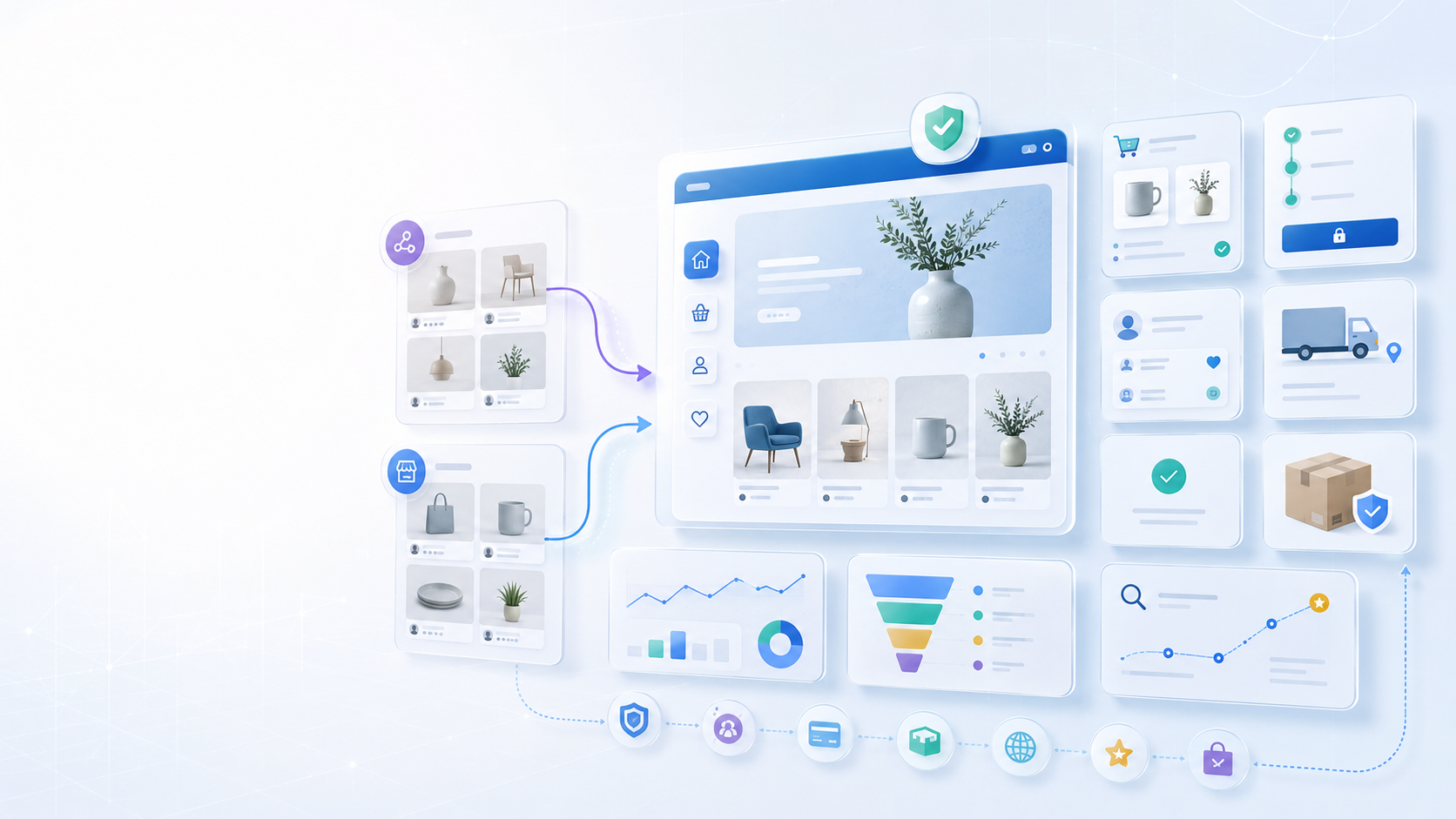
A dedicated e-commerce website gives the business a stronger foundation. It can present the brand properly, organise products clearly, accept payments, support search visibility, build trust, and make the customer journey more professional.
If your business sells physical products, handmade items, specialist goods, local products, beauty products, home items, clothing, accessories, food-related products, digital products, or custom orders, an online shop may be the next practical step.
EMPEX Digital can help plan and build e-commerce websites through our Web Design and Development service. You can also request a quote through our web design quote page or book a consultation to discuss whether an online shop is right for your business.
Online shopping is now a normal customer behaviour
E-commerce is no longer only for large retailers. Customers are comfortable discovering products online, comparing options, checking reviews, saving items, paying digitally, and arranging delivery or collection without visiting a physical store first.
The Office for National Statistics reported that internet sales accounted for 27.6% of total retail sales in Great Britain in May 2026. This shows that online buying remains a significant part of normal retail activity.
For small businesses, this creates an opportunity. A customer may discover the brand through social media, but they often expect a proper place to view products, read details, check prices, understand delivery options, and complete the purchase.
A business that only sells through direct messages may still make sales, but the process can feel slower and less professional. The customer may need to ask for prices, availability, payment details, delivery information, and order confirmation manually.
An online shop removes much of that friction. It gives customers a clear place to browse and buy when they are ready.
Social media is useful, but it should not be the only sales channel
Social media is excellent for product discovery. It allows a business to show new items, behind-the-scenes content, customer photos, promotions, live demonstrations, and brand personality.
The problem is that social media platforms are not fully controlled by the business. Algorithms change, reach can drop, accounts can be restricted, posts disappear quickly, and customers may struggle to find product details after seeing something days or weeks earlier.
A social media profile is also not always the best place to manage a full buying journey. Comments and direct messages can become messy when several people ask about sizes, colours, stock, delivery, payment, and collection at the same time.
A better approach is to use social media as a discovery channel and the online shop as the place where customers complete the buying journey. A post can introduce the product, while the website provides the details, options, checkout, delivery information, policies, and confirmation.
This gives the business more structure. Instead of depending on manual conversations for every sale, social media can guide people towards a professional store that is open at all times.
Third-party marketplaces can help, but they come with limits
Marketplaces such as Etsy, eBay, Amazon, and other specialist platforms can give small businesses access to customers who are already searching for products. For some businesses, this can be valuable.
However, marketplaces also create limitations. The business has to operate within another company’s rules, fees, search system, design restrictions, customer communication policies, and competitive environment.
A customer may buy from the marketplace without remembering the business behind the product. The platform owns much of the relationship, and the business may have limited control over how the brand is presented.
There is also the risk of competing mainly on price. When many similar products appear side by side, customers may compare listings quickly and choose the cheapest option rather than the best brand or service.
An online shop does not mean abandoning marketplaces. Many businesses can use both. The key difference is ownership. A marketplace can support sales, but the business’s own website becomes the central home for the brand, content, product range, customer journey, and long-term growth.
Your own shop builds stronger brand trust
A dedicated e-commerce website allows the business to present itself properly. It can explain the story behind the brand, show product collections clearly, display high-quality images, include customer reviews, answer common questions, and make contact details easy to find.
This matters because customers often want reassurance before buying from a smaller business. They may ask whether the business is real, whether the product quality looks good, whether delivery is reliable, and whether customer support will be available if something goes wrong.
A professional website helps answer those questions before the customer contacts you. It can include an about page, delivery information, returns policy, secure checkout, FAQs, product care guidance, size guides, testimonials, and examples of previous work.
Trust is especially important for products that are handmade, customised, higher value, fragile, personal, or bought as gifts. Customers want to feel confident before entering payment details.
A well-designed online shop makes the business look more established and gives customers a clearer reason to buy directly.
Product information becomes easier to manage
When a business sells only through posts or messages, product information can become scattered. Prices may be in one post, colours in another, delivery details in a caption, and availability in the comments.
This makes it harder for customers and business owners. Customers have to ask basic questions, while the business spends time repeating the same information.
An online shop creates one organised product catalogue. Each product can have its own page with images, description, price, options, stock status, delivery information, care instructions, related products, and customer guidance.
This also helps with internal organisation. The business can update a product once instead of correcting old posts or replying manually to every enquiry. Seasonal products, limited collections, bestsellers, sale items, and new arrivals can be displayed in a structured way.
For growing product businesses, this structure saves time and improves the buying experience.
E-commerce supports search visibility
Social media posts can attract attention quickly, but they are not always easy to find later through search engines. A product page on your own website can continue working over time.
A well-structured e-commerce website can help customers find your products through Google and other search experiences. Product names, category pages, descriptions, images, internal links, FAQs, and blog content can all support visibility when they are planned properly.
For example, a business selling handmade candles, custom furniture, premium skincare, local food products, specialist tools, personalised gifts, or fitness accessories can create product and category pages that match what customers are already searching for.
This does not mean every online shop will rank immediately. Search visibility takes planning, useful content, technical SEO, and consistency. But a dedicated website gives the business a stronger foundation than relying only on social feeds that quickly move out of view.
EMPEX Digital’s SEO and Digital Growth service can help connect product pages, content, technical SEO, and customer journeys into a clearer growth strategy.
A better checkout process can reduce lost sales
Manual selling often creates extra steps. A customer may need to message the business, wait for a reply, confirm availability, receive payment details, send proof of payment, provide an address, and wait for confirmation.
Every extra step creates a chance for the sale to be lost.
A proper online shop can allow customers to choose products, select options, add items to a basket, pay securely, receive order confirmation, and understand what happens next. This does not only make the process faster; it also makes it feel safer and more professional.
Good checkout design should be simple, mobile-friendly, and clear. Customers should understand delivery costs, returns, payment methods, expected timescales, and any important product conditions before they complete the order.
For businesses that already receive interest through social media, improving checkout can turn more of that interest into completed purchases.
Customer data and repeat sales become easier to build
When customers buy only through third-party platforms, the business may have limited access to customer data and communication options. Platform rules may restrict how the business can follow up, promote future products, or build a direct relationship.
With an online shop, the business can begin building its own customer base more responsibly. This may include order history, email updates, customer accounts, abandoned basket reminders, loyalty offers, product recommendations, and post-purchase communication.
This must be handled properly. Customers should understand how their data is used, and marketing should follow the relevant privacy and consent rules.
The ICO explains that websites using cookies or similar technologies must tell people what is being used and why, and consent is required for non-essential cookies. You can read the ICO guidance here: Cookies and similar technologies.
A well-planned e-commerce website should therefore include not only design and products, but also privacy, cookie, and communication considerations.
Legal and policy information should be clear
Selling online brings responsibilities. Customers need clear information about the business, products, prices, delivery, cancellation rights, returns, refunds, and contact details.
The UK Government provides guidance on online and distance selling, including cancellation rights for many consumer purchases. You can read the official guidance here: Online and distance selling for businesses.
This is one reason a professional online shop is valuable. Important information can be presented in a clear and consistent way instead of being explained manually in messages.
Policies should not be hidden or copied without understanding them. A business should make sure its delivery, returns, refund, privacy, and terms pages match how it actually operates.
Good legal and policy information protects both the customer and the business. It reduces confusion, supports trust, and gives the buying journey a more professional foundation.
Not every business needs a complex online store immediately
An e-commerce website does not have to start as a large platform with hundreds of products, customer accounts, loyalty systems, and advanced integrations.
For many small businesses, the first useful version may be simple. It might include a small product catalogue, secure checkout, delivery information, contact options, basic SEO setup, analytics, and a clear order notification process.
The website can then grow over time. Later improvements may include product filters, email marketing, abandoned basket recovery, advanced shipping rules, discount codes, customer accounts, stock management, product bundles, subscriptions, or integration with accounting and fulfilment systems.
The right starting point depends on the business. A handmade product seller, local food producer, clothing brand, trade supplier, and digital product business will not all need the same setup.
A good e-commerce project should begin with the current sales process, product range, customer journey, and realistic budget. From there, the website can be planned in phases instead of overcomplicating the first launch.
How to know if your business is ready
A business may be ready for an online shop if customers already ask how to buy, products are being sold through direct messages, social media interest is growing, manual order handling is becoming slow, or marketplace fees and limitations are starting to feel restrictive.
It may also be time to consider e-commerce if the business wants to look more professional, reach customers outside the local area, organise product information properly, improve repeat sales, or build a stronger brand that is not dependent on one platform.
The first step does not need to be a full build. A discovery conversation can identify the product range, target customer, current sales channels, payment needs, delivery process, legal pages, content requirements, and likely technical setup.
This helps determine whether the business needs a simple online shop, a larger e-commerce website, or a phased approach that starts with product visibility before adding full checkout.
Final thoughts
Social media and marketplaces can be useful for product-based businesses, especially in the early stages. They help with visibility, testing demand, and reaching customers who are already active on those platforms.
But they should not be the only foundation for long-term growth.
A dedicated e-commerce website gives the business more control over its brand, product information, customer journey, checkout process, search visibility, policies, data, and future development. It creates a central place where customers can discover, trust, and buy from the business directly.
For many product-based businesses, the strongest approach is not social media or website. It is both. Social media can create attention, while the online shop turns that attention into a clearer and more reliable buying journey.
To discuss an e-commerce website for your business, explore our Web Design and Development service, request a quote through our web design quote page, contact EMPEX Digital, or book a consultation.
Keep reading
Related insights
More practical guidance to help improve visibility, conversion, enquiries, and digital systems.
Why Growing Businesses Should Use Email on Their Own Domain
A Gmail or Outlook address may be enough when a business is just starting, but a custom-domain email creates stronger ownership, consistency, security, and room to grow. Here is why professional email infrastructure matters.
The Real Risk of Free Website Offers for Small Businesses
Free website offers may sound attractive, especially from new developers building a portfolio. But for serious businesses, a free website can create hidden costs, ownership problems, weak SEO, security risks, and expensive repairs later.
What to Prepare Before Requesting a Website Quote
A better website quote starts with clearer information. Learn what small businesses should prepare before requesting a website design or redesign quote, including goals, pages, content, features, integrations, SEO needs, and aftercare expectations.
Discussion
Comments
No comments yet
Be the first to share a useful thought, question, or takeaway from this article.