
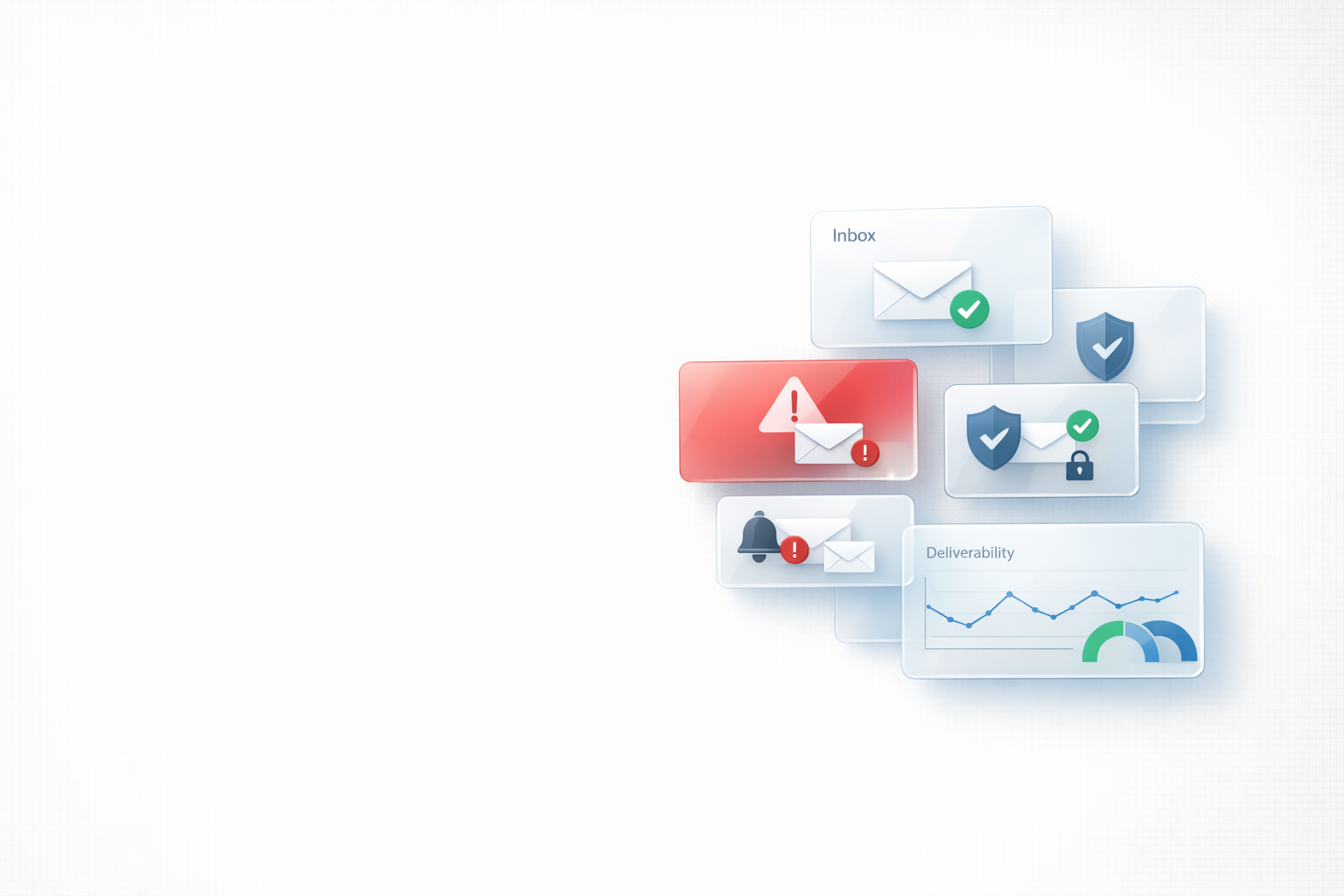
Quick check
Are your website enquiries reaching the right place?
If your website looks fine but leads are quiet, the issue may be hidden in your forms, email delivery, contact flow, messaging, or visibility.
Why Emails Going to Spam Can Quietly Damage Your Business
A lot of businesses only notice email problems when something becomes obvious.
A client says they never received the quote. A lead claims there was no reply. A follow-up goes unanswered. A contact form appears to be working, but conversions feel lower than expected. On the surface, these can look like isolated issues.
In reality, they are often signs of a deeper deliverability problem.
When business emails go to spam, the damage is rarely dramatic at first. It is usually quiet. Messages still appear to send. Systems still seem to work. The team assumes communication is happening. But in the background, important emails may be landing in junk folders, being filtered heavily, or arriving with lower trust.
That is what makes the issue so costly. It can affect enquiries, sales, support, and customer confidence without creating a single obvious technical failure.
For UK SMEs, this matters more than many realise. Email still sits at the centre of everyday business communication. Quotes, confirmations, support replies, bookings, invoices, and follow-ups often depend on it. If deliverability is weak, the business does not only have a technical issue. It has a commercial issue.
If you need support improving this part of your setup, explore our Email Infrastructure service or book a consultation.
The problem is not just “spam” in the usual sense
When people hear the word spam, they often think of obvious junk mail.
But business deliverability problems are usually more subtle than that.
A legitimate email can still be filtered, downgraded, delayed, or treated with suspicion by receiving systems. That means a real quote, a genuine follow-up, or an important first reply can fail to land where it should.
From the sender’s side, everything may look normal. The email was sent. No major error appeared. The inbox seems fine. But the result on the other side is different.
This is why businesses sometimes underestimate the issue. There is no dramatic outage. There is just a slow leak in communication.
And because it is hard to see directly, the business often misreads the symptoms. It may assume leads are going cold more quickly. It may assume prospects are unresponsive. It may assume the website is underperforming. In some cases, the real problem is that key messages are simply not landing properly.
Missed or delayed trust can cost more than one email
A lot of customer communication depends on momentum.
Someone sends an enquiry. They expect acknowledgement. They expect the business to look responsive and organised. Even if the service is excellent, trust starts forming from those first moments.
If the first reply lands in spam, the customer experience changes immediately.
The prospect may think the business ignored them. They may move on to a competitor. They may start with less confidence even if they eventually find the message later. A slow or broken communication path creates uncertainty, and uncertainty reduces conversion.
This is especially important for service businesses, agencies, trades, and local companies where the initial enquiry stage is often the first real point of contact.
A business may spend time and money generating leads through SEO, social content, ads, or referrals, but weak email delivery can quietly reduce the value of all that work.
That is one reason deliverability should be viewed as part of the wider enquiry journey, not just an IT concern. If your website is driving leads but communication is weak, the full system underperforms. Our SEO service can help bring the right traffic in, but the follow-up layer needs to work properly too.
Contact forms are often affected more than businesses realise
One of the most common weak points is the contact form process.
From the customer’s perspective, they submit the form and expect a reply. From the business side, the form may create an email notification, send an autoresponder, or trigger a workflow.
If those messages do not land reliably, the business can lose visibility very quickly.
Sometimes the internal notification goes missing, so the team does not realise a lead arrived. Sometimes the confirmation email to the customer goes to spam, which makes the business feel less responsive or less trustworthy. Sometimes both sides assume the other side failed to act.
This creates confusion that can look like low demand, poor conversion, or weak lead quality when the underlying issue is actually message delivery.
That is why email infrastructure matters even for businesses that are not running large campaigns. Simple day-to-day website and enquiry flows depend on it.
If that part of your setup feels unreliable, our Email Infrastructure service is designed to help businesses improve deliverability, trust, and sending performance.
Deliverability affects brand trust as well as communication
A poor email setup does not only create missed messages. It can also affect how professional the business feels.
Customers notice small signals. They notice when confirmations feel inconsistent, when replies do not arrive, when domains look unfamiliar, or when messages appear with warnings. Even if they do not fully understand the technical side, they respond to the trust signals around it.
A strong setup supports a stronger brand impression.
That includes using the right sending domain, aligning forms and business email properly, and making sure messages are authenticated and structured in a way that major inbox providers recognise as legitimate.
This is one reason infrastructure quality matters so much. Good technical foundations support better communication, and better communication supports stronger trust.
The issue often shows up after growth or system changes
Many businesses do not run into deliverability problems immediately.
The trouble often appears after the setup becomes more complex.
A website is rebuilt. A new form plugin is added. Email sending moves to another provider. Marketing tools get connected. Staff start sending from different systems. A domain is reconfigured. DNS records are incomplete. Authentication is missing or inconsistent. The business adds automation without reviewing the sending reputation behind it.
None of these changes are unusual. In fact, they often happen naturally as the business grows.
But this is exactly why reviews matter. A setup that looked fine at one stage can become fragmented over time. Small issues build up until the communication layer becomes less reliable than the business assumes.
That is why some of the most useful technical work is not flashy. It is simply making sure the underlying systems are working properly, consistently, and in alignment.
Better deliverability protects the value of your follow-up
Good follow-up is one of the biggest advantages a small business can have.
A clear reply, a fast quote, a useful reminder, or a timely update can be the difference between winning and losing work. But follow-up only creates value when it actually reaches the person it was meant for.
This is where deliverability connects to wider automation and operational systems. Businesses may start using smarter follow-up flows, lead nurturing, appointment reminders, or AI-assisted response systems. Those improvements can be very effective, but only when the communication foundation is sound.
There is little value in improving follow-up strategy if the messages behind it are weakened by poor email configuration.
That is why infrastructure should come first. Once the base is reliable, the wider communication journey becomes much stronger. If you are also looking at process improvements around responses and lead handling, our AI Integration service can help connect those systems properly.
The warning signs are often easy to miss
Because spam issues are quiet by nature, the warning signs are usually indirect.
A business may notice that enquiry replies seem inconsistent. It may find that some customers say they never received information. It may feel that forms are underperforming despite traffic looking reasonable. It may see open or response behaviour change after moving systems. It may struggle with one provider more than another.
These are the kinds of patterns that should not be ignored.
They do not always mean there is a deliverability problem, but they often justify a proper review. The earlier the issue is identified, the less damage it causes over time.
The longer it continues, the more trust, opportunities, and efficiency the business may lose without realising why.
Final thoughts
Emails going to spam can quietly damage a business because the effects are often invisible at first.
You may still be sending messages. Your website may still appear functional. Your team may still believe the process is working. But if important communication is not landing properly, the business is losing trust and opportunities in ways that are easy to misread.
For many SMEs, this is not just a technical detail. It affects enquiries, customer experience, internal efficiency, and commercial performance.
If your business relies on website forms, client replies, quotes, confirmations, or automated follow-up, email delivery should be treated as a core part of your digital setup.
If you want help improving the technical foundations behind your business communication, explore our Email Infrastructure service, contact us, or book a consultation.
Keep reading
Related insights
More practical guidance to help improve visibility, conversion, enquiries, and digital systems.
Why Growing Businesses Should Use Email on Their Own Domain
A Gmail or Outlook address may be enough when a business is just starting, but a custom-domain email creates stronger ownership, consistency, security, and room to grow. Here is why professional email infrastructure matters.

The Real Risk of Free Website Offers for Small Businesses
Free website offers may sound attractive, especially from new developers building a portfolio. But for serious businesses, a free website can create hidden costs, ownership problems, weak SEO, security risks, and expensive repairs later.
Why Product-Based Businesses Should Consider Their Own Online Shop
Social media and marketplaces can help product-based businesses get attention, but relying only on third-party platforms can limit control, trust, customer data, and long-term growth. Learn why a dedicated e-commerce website can create a stronger foundation.
Discussion
Comments
No comments yet
Be the first to share a useful thought, question, or takeaway from this article.