
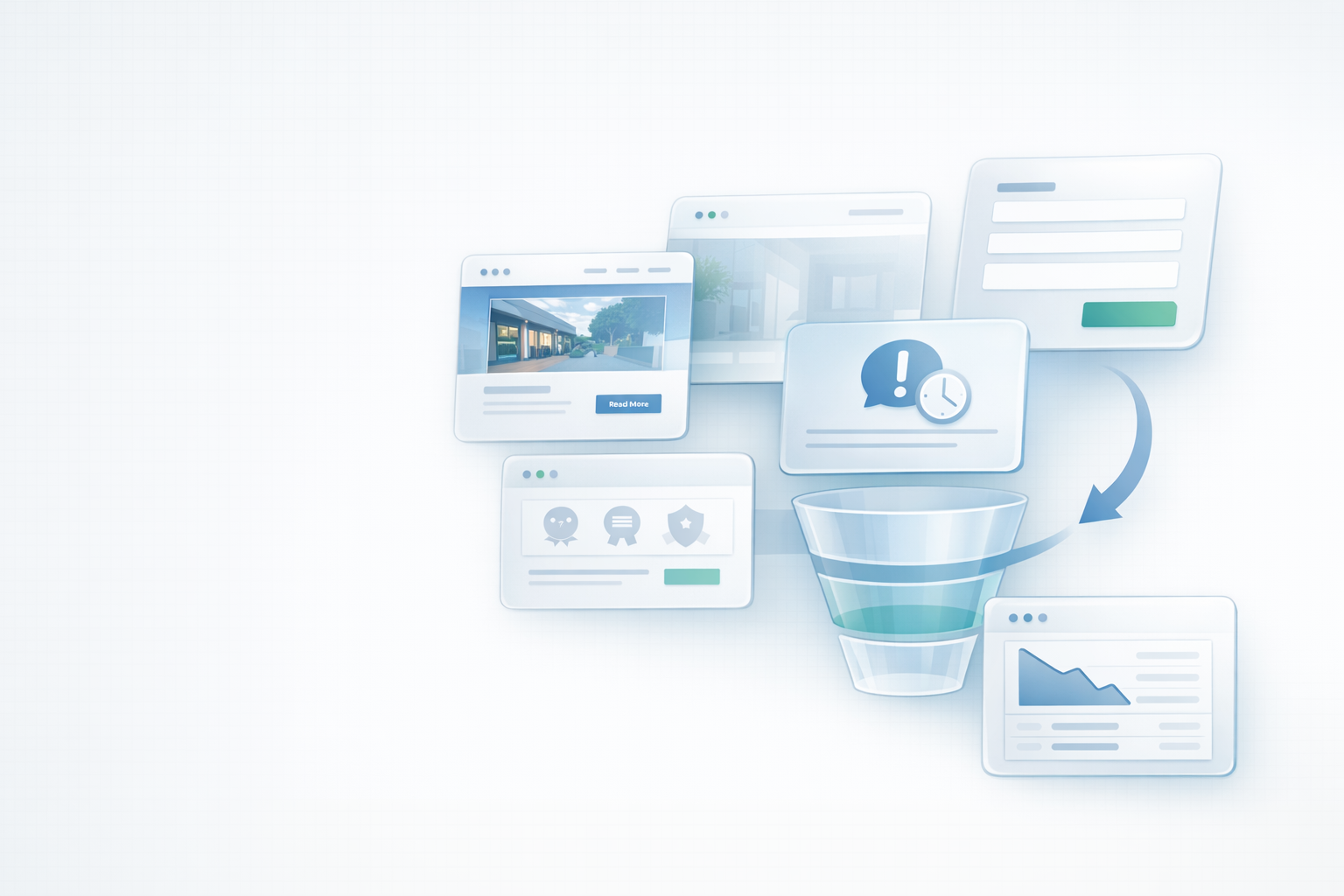
Quick check
Are your website enquiries reaching the right place?
If your website looks fine but leads are quiet, the issue may be hidden in your forms, email delivery, contact flow, messaging, or visibility.
Why Most Small Business Websites Lose Enquiries Before the First Call
A lot of small business owners assume that if their website is not generating enough enquiries, the main problem must be traffic.
Sometimes that is true. But in many cases, the bigger problem is what happens after someone lands on the site.
The website may be getting attention, but it is quietly losing people before they ever make contact. Not because the business is poor, and not because the service is weak, but because the site does not create enough confidence, clarity, or momentum for the visitor to take the next step.
This happens more often than people realise.
A potential customer arrives, scans the page for a few seconds, and starts making quick decisions. Do these people look trustworthy? Do they clearly offer what I need? Do I understand what happens next? Is it easy to contact them? Do they feel current and professional?
If the answer feels uncertain, the visitor often leaves without enquiring.
That is the real issue. Many small business websites lose leads before the first call, before the first email, and before the first form submission.
If you want help improving this, explore our Web Design service or book a consultation.
The problem is often confidence, not just design
When business owners think about website performance, they often focus on appearance first.
Design matters, of course. A dated or messy website can absolutely hurt trust. But the deeper issue is usually confidence.
A website needs to help the visitor feel that they are in the right place, dealing with the right business, and moving towards the right solution.
That confidence is built through many small signals working together.
The page needs to be clear. The offer needs to make sense. The structure needs to feel easy. The wording needs to sound human and professional. The trust signals need to appear at the right moments. The contact path needs to feel simple.
When those pieces are weak, the website may still look acceptable on the surface, but it will struggle to convert interest into action.
That is why some businesses keep investing in traffic without seeing much improvement. More visitors arrive, but the same friction remains in place.
Visitors decide very quickly whether to stay
Most people do not read websites from top to bottom.
They scan. They look for clues. They try to understand the offer quickly. They check whether the business feels relevant to their situation. If that process takes too much effort, they leave.
For a small business website, the first screen matters more than many owners think.
If the opening section is vague, the visitor has to work too hard to understand what the business actually does. If it looks generic, trust falls. If the call to action is unclear, momentum disappears.
This is why broad phrases often underperform. A headline like “Quality solutions for modern businesses” sounds polished, but it does not tell the visitor much. A clearer headline that explains the service and the outcome usually performs better because it removes doubt earlier.
The goal is not to sound clever. The goal is to make the next decision easier.
Many websites do not answer the visitor’s real questions
A common weakness on small business websites is that they talk around the service instead of properly explaining it.
The site may contain good intentions, but not enough practical clarity.
A visitor usually wants to know simple things. What exactly do you do? Who is it for? What is included? Why should I trust you? What happens if I contact you? How quickly will someone reply?
If those answers are missing, the website creates uncertainty.
That uncertainty is expensive because it slows people down. Some will leave immediately. Others will delay contacting you and compare alternatives instead. In both cases, the site has made the path harder than it needed to be.
This is why high-performing service websites are usually not the ones with the fanciest wording. They are the ones that make the service feel understandable, trustworthy, and easy to choose.
Weak contact journeys lose more leads than most businesses realise
Even when a visitor is interested, the contact process itself can still cause drop-off.
Sometimes the form is too long. Sometimes the button is hard to find. Sometimes there is no reassurance about what happens next. Sometimes the page asks for too much commitment too early. Sometimes the contact details exist, but the next step feels unclear.
This matters because people are often slightly hesitant when contacting a business for the first time. They do not want friction. They do not want uncertainty. They do not want to feel ignored.
A good website reduces that hesitation.
It makes the next step visible. It explains what will happen after the enquiry. It keeps the process simple. It gives the visitor enough reassurance to move forward.
This is one reason it helps to connect website improvements with wider enquiry handling. If your site makes it easy to get in touch, but follow-up is slow, leads can still be lost. That is where our AI Integration service can also help by improving how enquiries are handled behind the scenes.
Trust signals need to appear near decisions
Many websites do have proof, but it sits in the wrong place.
A testimonial hidden on a separate page, or a few vague claims buried near the footer, will not do enough when the visitor is deciding whether to make contact.
Trust works best when it appears close to the decision point.
That might be a short review near the main call to action. It might be a simple results statement. It might be a few strong points about experience, response time, location, or process. It might be a small case-study section showing what kind of problems you solve.
The purpose is not to overload the page with claims. It is to reduce uncertainty at the moment when the visitor is deciding whether to trust you.
This is especially important for local service businesses, where people are often comparing several options quickly.
Mobile experience quietly affects conversion
A lot of SME websites are reviewed mainly on desktop, even though many real visitors arrive on mobile.
This creates a gap.
A page that feels acceptable on a laptop may feel frustrating on a phone. Text may look too cramped. Buttons may be awkward. trust signals may sit too low on the page. Contact forms may feel too long. Important details may not appear early enough.
When that happens, the site starts losing enquiries quietly.
Not every visitor will complain. Most will just leave.
A better mobile experience is not only about responsive layout. It is also about structure. The order of information matters. The clarity of the offer matters. The simplicity of the call to action matters.
A strong small business website should feel easy to trust and easy to use on the device people are most likely to have in their hand.
More traffic will not fix a weak conversion path
This is one of the most important points.
Businesses often assume that once traffic increases, enquiries will improve automatically. But if the website is already creating friction, more traffic simply means more people meeting the same weak experience.
That is why conversion work matters.
Before putting more effort into ads, SEO, social content, or outreach, it often makes sense to review whether the site is doing its job properly once someone arrives.
Can a new visitor understand the offer quickly?
Can they see why the business is credible?
Can they find a clear next step?
Can they enquire without friction?
Do they feel confident enough to act now?
If the answer to those questions is weak, improving the website can often increase enquiry performance without increasing traffic at all.
If you also want to improve visibility, our SEO service can help bring the right visitors in alongside stronger page structure.
What to improve first
For most small business websites, the first improvements are usually not complicated.
The homepage message often needs to become clearer. Service pages often need more structure. Trust signals often need better placement. Contact journeys often need to feel simpler and safer. Mobile layouts often need to be reviewed more seriously. Internal calls to action often need to be stronger and more consistent.
These changes may sound small, but together they can change how the website feels to a new visitor.
And that feeling matters.
People rarely say, “I left because the site lacked enough clarity and momentum.” They just move on. But that is often what happened.
A better website does not only look more modern. It reduces hesitation. It helps the visitor trust faster. It makes action feel easier.
That is what protects enquiries before the first call ever happens.
Final thoughts
If your website is getting attention but not enough enquiries, it is worth looking beyond traffic alone.
The real issue may be that visitors are losing confidence too early. They may not be seeing enough clarity, enough reassurance, or an easy enough next step to contact you.
That does not always require a complete rebuild. But it usually does require a more honest review of how the website feels to someone who does not know your business yet.
If you want to improve how your website turns visitors into real enquiries, explore our Web Design service, contact us, or book a consultation.
Keep reading
Related insights
More practical guidance to help improve visibility, conversion, enquiries, and digital systems.

Why Growing Businesses Should Use Email on Their Own Domain
A Gmail or Outlook address may be enough when a business is just starting, but a custom-domain email creates stronger ownership, consistency, security, and room to grow. Here is why professional email infrastructure matters.
The Real Risk of Free Website Offers for Small Businesses
Free website offers may sound attractive, especially from new developers building a portfolio. But for serious businesses, a free website can create hidden costs, ownership problems, weak SEO, security risks, and expensive repairs later.
Why Product-Based Businesses Should Consider Their Own Online Shop
Social media and marketplaces can help product-based businesses get attention, but relying only on third-party platforms can limit control, trust, customer data, and long-term growth. Learn why a dedicated e-commerce website can create a stronger foundation.
Discussion
Comments
No comments yet
Be the first to share a useful thought, question, or takeaway from this article.